
Introduction
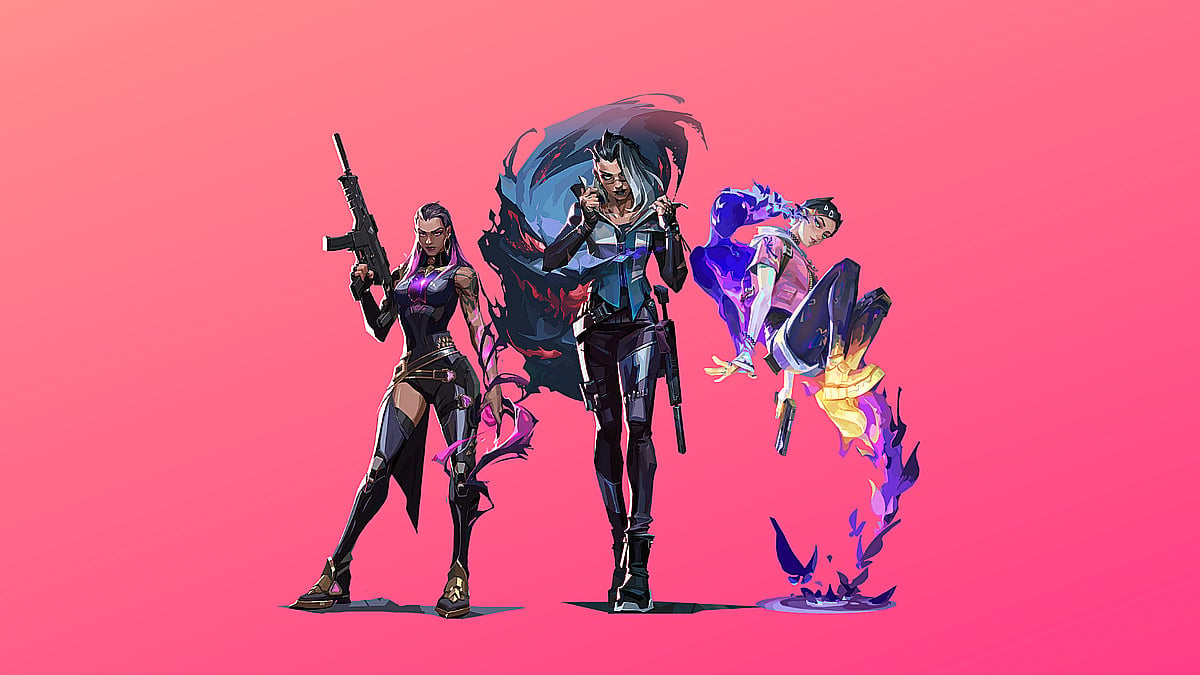
While VALORANT divides agents into roles, each agent still has distinct kits. Some require communication to extract value from their kit. Others have self-sustaining kits and can play off their own abilities without much coordination.
Breach and KAY/O are a good example of this contrast. Breach’s kit requires a teammate to play off it, whether it’s his flashes or stuns, making him hard to run in a team that doesn’t communicate. KAY/O, on the other hand, can easily play off his own flashes, nades, and knife for info.
In ranked, teams often lack synergy and communication, making it hard to play agents that require coordination. It’s much better to opt for agents that can provide value to the team without needing setup from someone else. That makes it easier to execute plays without relying on a teammate.
In this guide, we’ve broken down agents from each class that are self-sufficient, require minimal coordination, and have the potential to solo-carry.
Duelists
Duelists are the space makers of the team. They need to create space and enter sites to help their team move up behind them. Duelists need utility from their initiators and controllers to have the best chance at surviving and eliminating enemies.
In ranked matches, the lack of communication leaves the duelist alone and unsupported. To counter this, you need a self-sufficient duelist who can win the fight and survive afterward.
Reyna
Reyna is the single most self-sufficient agent in VALORANT. Her whole kit runs on a single loop: get a kill, then Devour to heal or Dismiss to become invulnerable and reposition. She has two wall-piercing blinds she can use on herself, without needing a teammate to combo with.
Reyna is an aimer’s dream. If you have solid aim and game sense, she can single-handedly carry games from Iron to Plat. Her kit requires nothing from her teammates.
Reyna’s ceiling flattens out in higher-ranked games, where teamwork and coordination matter more. She offers nothing to her team because her utility only benefits her, and her impact drops off sharply once kills stop coming easily, since kills are her only means of escape. Still, she’s a great agent to stomp lower-ranked lobbies with.
Jett
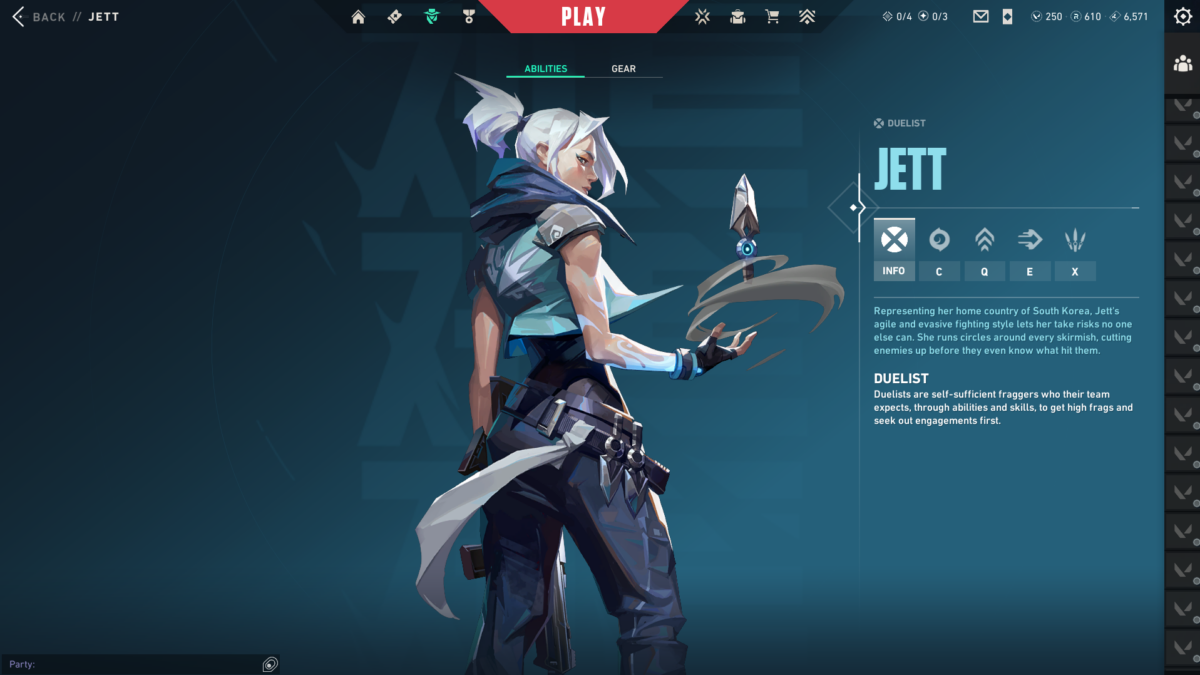
Jett is one of the most played agents in ranked VALORANT. She’s one of the starter agents already unlocked when you first launch the game. Jett has two smokes that help her get out of sticky situations easily. You can also use them to one-way certain angles, giving you the advantage against enemies.
Her updraft lets her get onto off-angles, and Tailwind helps her escape if something goes wrong. You can take high-risk fights all game and get out freely, needing no teammate to bail you out. Her ultimate, Bladestorm, equips her with highly accurate knives that can kill a fully armored opponent with a headshot, making it great for eco rounds.
Jett is also one of the best Operator agents in the game. A well-timed peek at an off-angle can get you the opening pick, making it easier for your team to close out the round. You can then quite safely dash away from that off-angle without getting punished.
She needs more mechanical investment than Reyna, but once you get it down, she can create space and get picks entirely on her own.
Phoenix
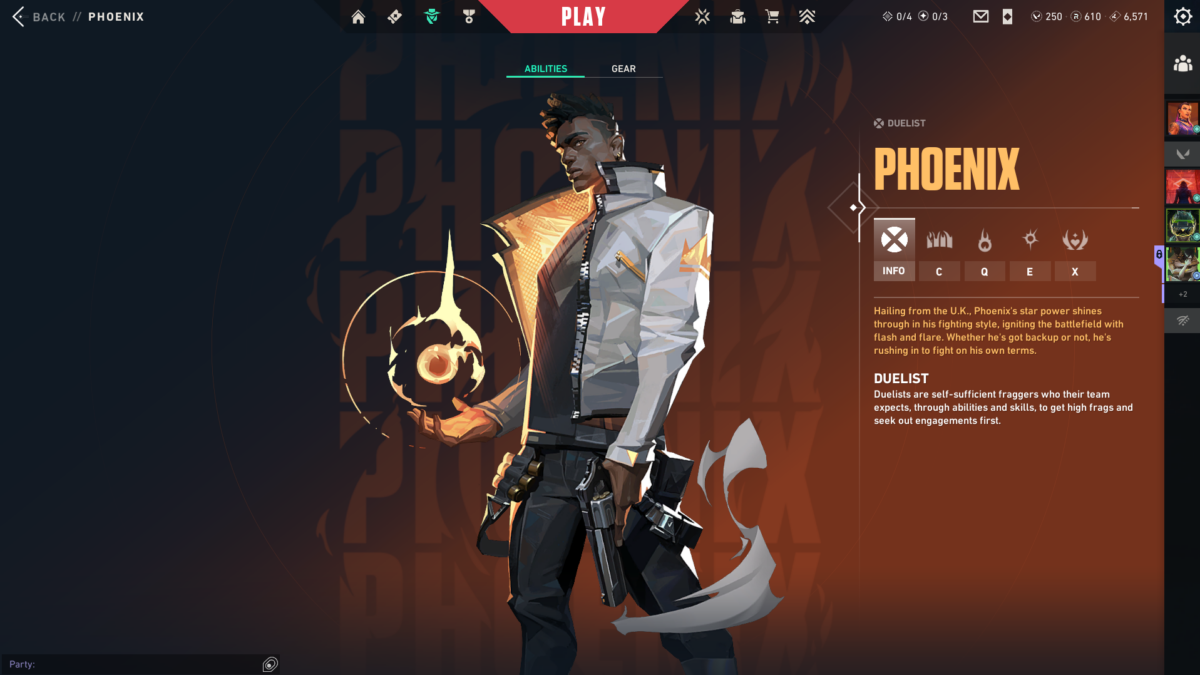
Phoenix is the lowest-maintenance duelist on this list, and another starter agent you get when you first launch into the game. His kit works whether you’re solo queuing or running coordinated team plays.
He has a self-flash similar to Reyna’s Devour, called Curveball, that you don’t need a teammate to play off of. Just flash yourself into an angle and take a favorable fight. Blaze and Hot Hands are his other two abilities, useful for healing yourself or dealing damage to opponents.
Blaze lasts around 8 seconds, which is enough time to defuse the spike, giving Phoenix another practical use beyond fighting. His ultimate, Run It Back, basically gives you an extra life.
He isn’t strictly a solo agent, but the forgiving nature of his kit makes him a safe bet for solo queue.
Initiators
Initiators are usually the most team-dependent class. Their abilities are built to be followed up on by teammates. A good initiator can still change the outcome of a game single-handedly, and two initiators in particular hold up well as solo queue picks.
Sova
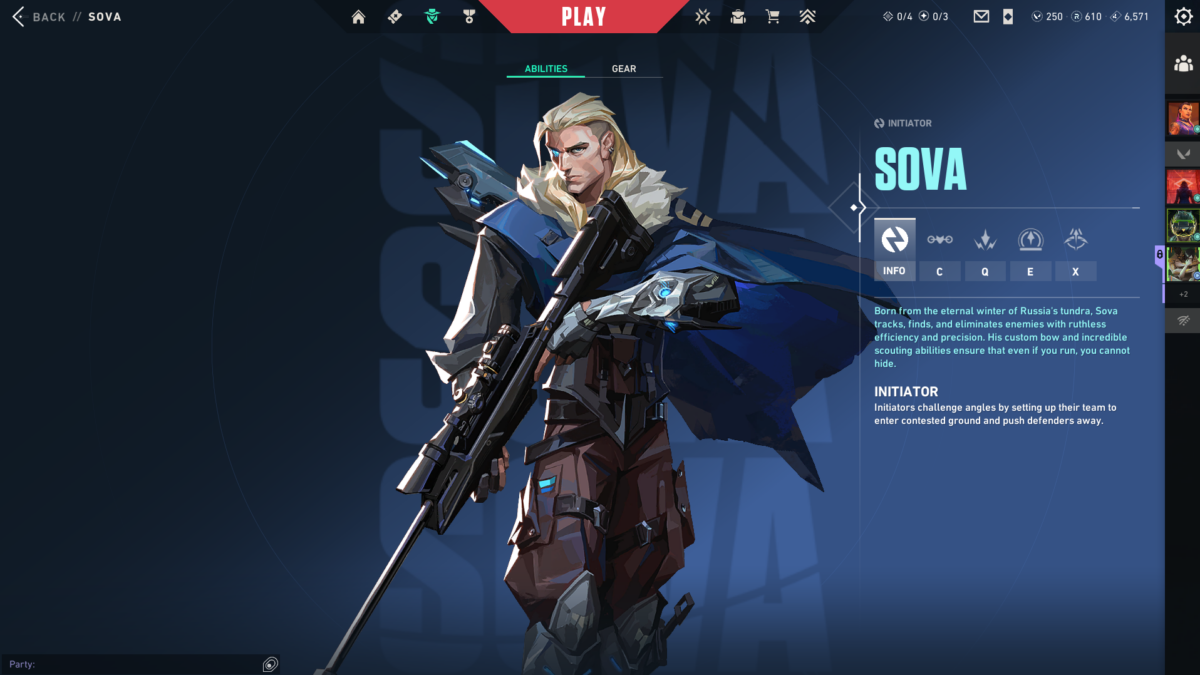
Sova is another starter agent for new VALORANT players. He falls under the info-initiator subcategory. His Recon Bolt and Owl Drone reveal enemy positions, and his Shock Bolt deals damage. His ultimate, Hunter’s Fury, fires three long-range, wall-piercing energy blasts that damage and briefly reveal enemies, visible only to Sova.
That said, his ceiling is extremely high. It’s directly tied to how many map-specific lineups you know. Most enemies already know the common Recon Bolt spots, so you need to be able to surprise them to get useful info.
He’s good for solo queue because you can help your teammates without much communication. As an attacker, you can recon and drone to quickly gather info for your team. As a defender, you can use the recon to get early info and call for your team to rotate accordingly.
Fade
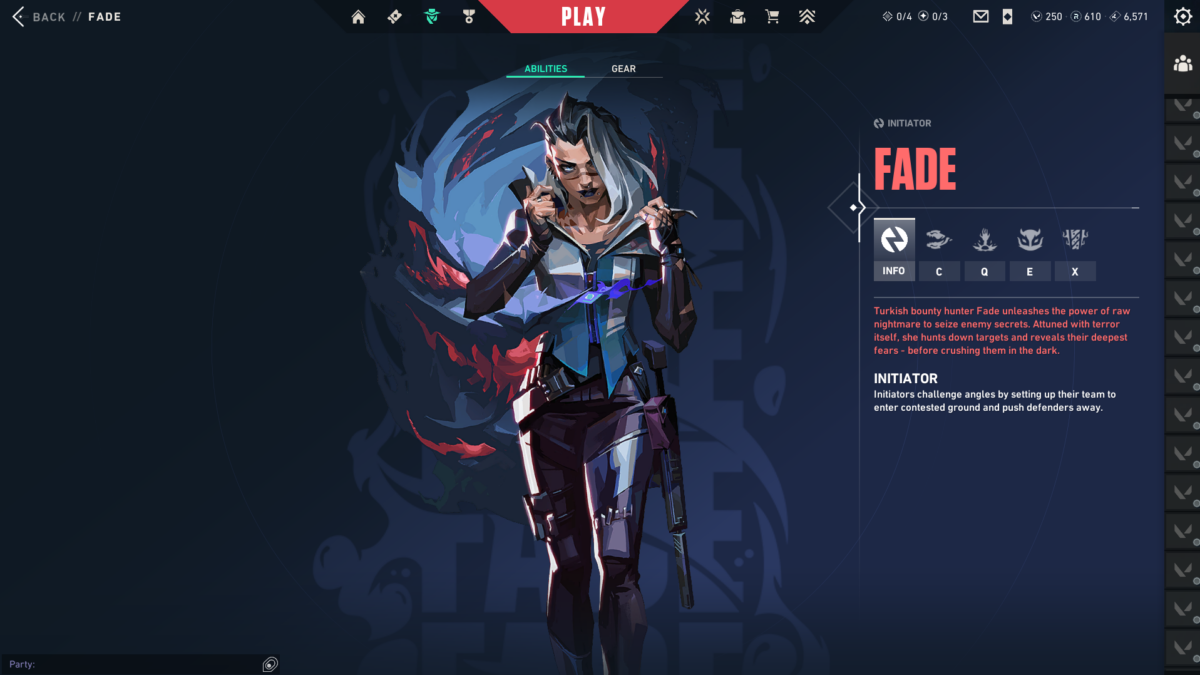
Fade is the more forgiving pick for players who don’t want to memorize a wall of lineups. She’s also an info initiator.
Her signature ability, Haunt, reveals enemies through walls with zero setup knowledge required: you throw it, get a read, and act. Her other abilities add value independently too. Prowlers apply pressure on their own, and Seize debuffs enemies without requiring a teammate’s follow-up to take effect.
Where Sova rewards hours of lineup practice, Fade delivers value from your very first game on a map, which makes her the safer solo-queue initiator if you’re still learning callouts.
Controllers
Controllers, as the name suggests, are the most important class for team executes. They lay down smokes on sites to help their team push up safely.
Most controllers are passive by nature, but the two below can smoke effectively and still frag out when needed.
Omen
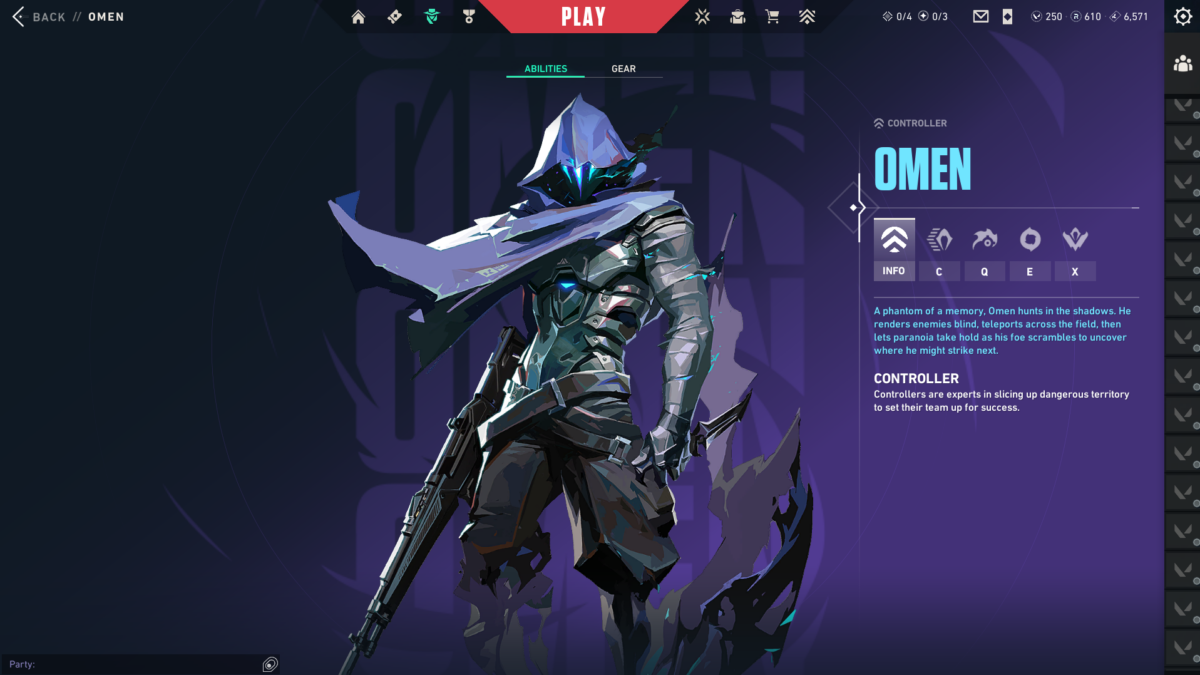
Omen has two abilities that help him get out of bad situations or leave enemies stunned. His signature ability, Dark Cover, throws smokes for site executions. He also has a nearsight, Paranoia, that reduces vision and deafens anyone it hits for a short time.
Shrouded Step lets him teleport across the map to flank, reposition, or bail out of a bad spot. His ultimate, From The Shadows, lets him teleport to any part of the map. It can be cancelled by an enemy shooting it, or by Omen himself.
This range of tools makes Omen a good solo queue pick. He can easily fit so many playstyles. He can be a lurker, or he can also be aggressive with his Paranoia and Shrouded Step. It’s his versatility that makes him one of the best solo-queue controllers in the game.
Clove
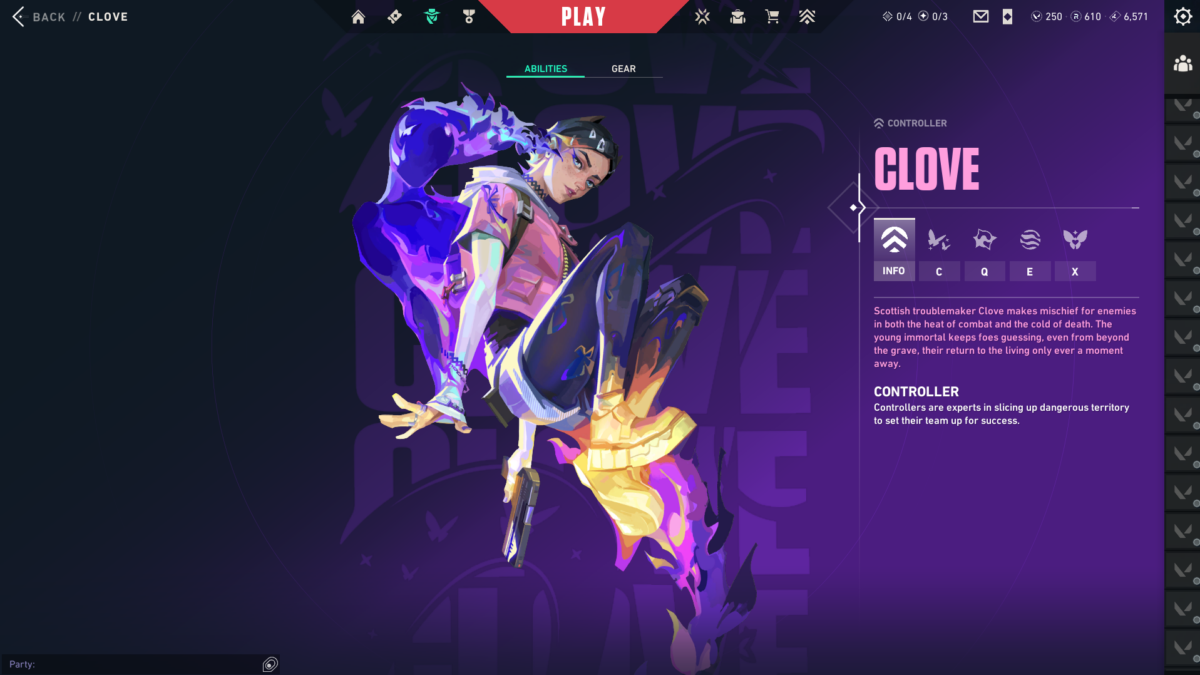
Clove is one of the most-picked agents in solo queue, and one of the highest win-rate agents too. The reason is simple: their kit is self-sustaining in a way no other controller’s is. They play like a duelist and controller mixed into one.
Clove’s signature ability is Ruse, smokes placed similarly to Brimstone’s. They have shorter smoke duration than most controllers, but Clove is the only agent who can smoke after death, giving their team cover even once they’re down. Pick Me Up lets them heal after killing or damaging an enemy, similar to Reyna’s Devour. Meddle is a throwable fragment that erupts after a delay, inflicting decay on enemies in its radius.
Clove’s ultimate, Not Dead Yet, works similarly to Phoenix’s Run It Back. After dying, they have a short window to activate it. Once resurrected, Clove has a limited window to secure a kill or assist, or they die again.
Clove’s kit leans toward combat more than a traditional controller’s, so you don’t need teammates to be impactful in a game.
Sentinels
Sentinels hold down a site or a flank alone, so by design they’re the most naturally solo-queue-friendly class. Two sentinels in particular can change a game by themselves, though they play very differently.
Chamber
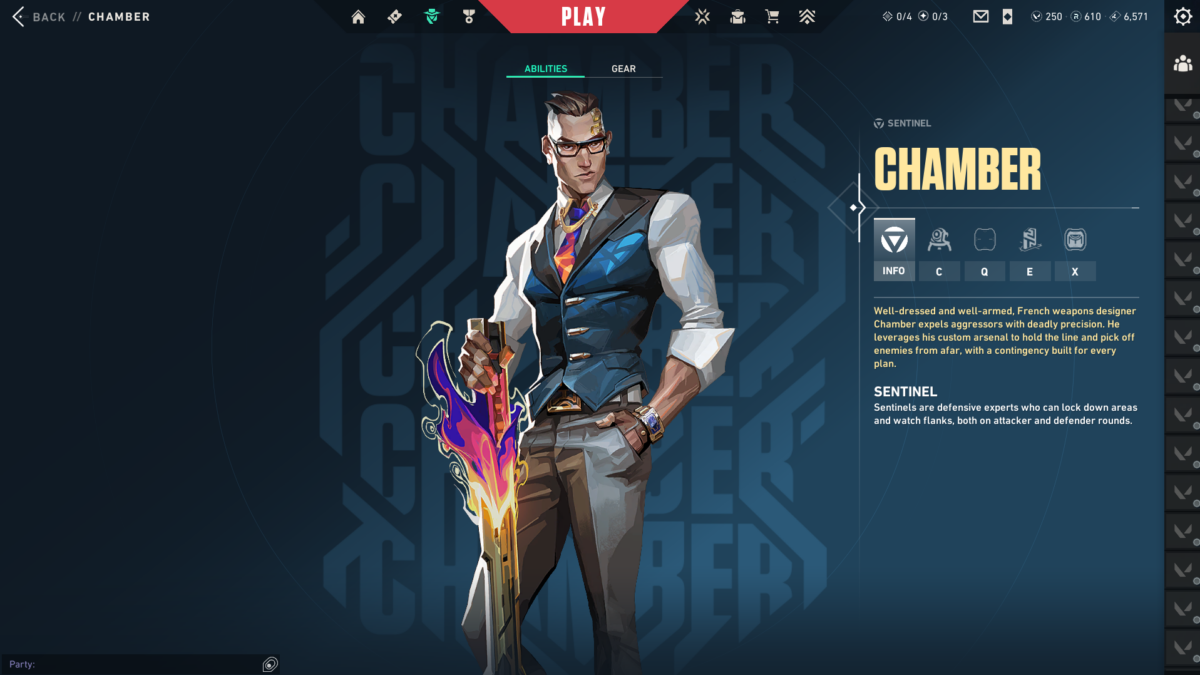
Chamber is a sentinel built for players who’d rather win a gunfight than avoid one. He’s a pseudo-duelist who has a get out of jail free card allowing him to take aggressive fights and escape easily if things get sour.
His Trademark is one of the best flank-watching tools in the game. Place it somewhere the enemy has to cross to flank, and you and your team don’t have to worry about that angle.
His signature ability, Rendezvous, lets him place an anchor he can teleport back to whenever he wants, as long as he’s in range. This gives him the freedom to take early picks aggressively, because if he misses, he can safely reposition. Chamber is also a strong Operator agent, much like Jett.
He carries a pocket Headhunter, a one-shot pistol with a faster equip time and the ability to aim down sights. His ultimate, Tour De Force, summons a custom sniper rifle that kills any enemy with a single direct hit to the upper body, regardless of armor, with faster ADS and a higher rate of fire than the standard Operator. Killing an enemy with it creates a slowing field similar to Trademark’s.
Chamber rewards the same aggressive, self-reliant playstyle Reyna offers, but with the added ability to stop site executions outright. His kit has kept him one of the more consistently picked agents in solo queue.
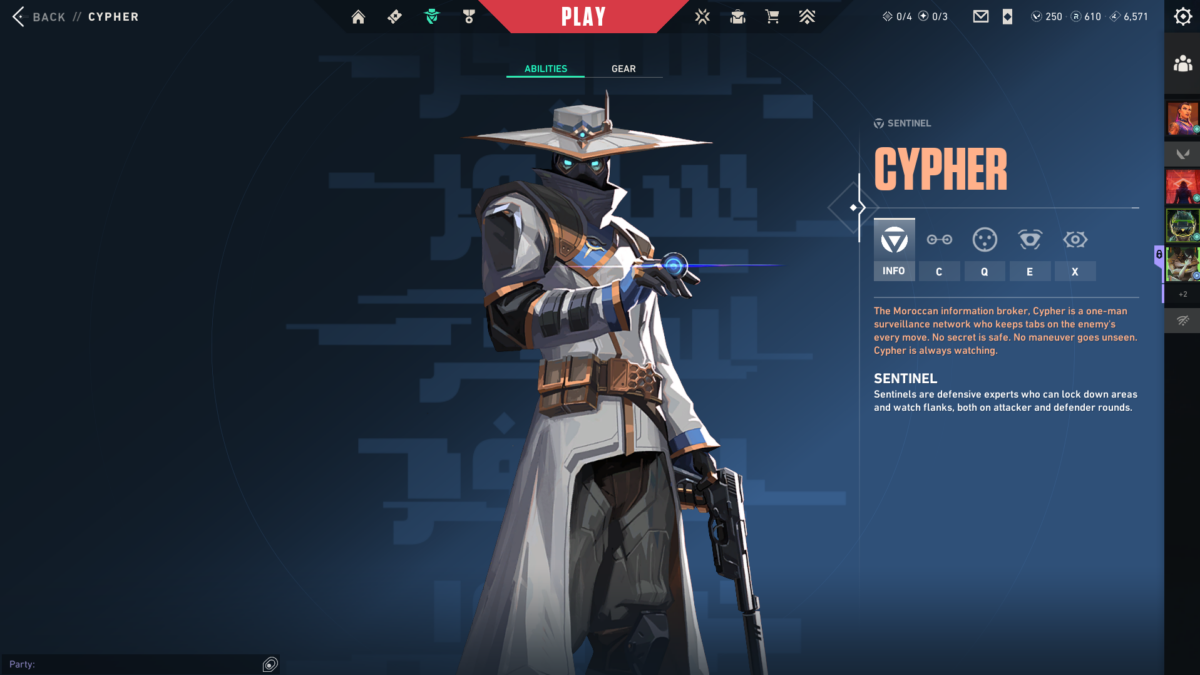
Cypher
Cypher is the traditional sentinel, with heavy stopping power and strong control over sites. His kit takes more setup time and lineup knowledge than most, but rewards you with real security over a site and the map around it.
His signature ability, Spycam, lets you safely spot and mark enemies from a distance. Trapwires and Cyber Cages help you defend sites while dodging enemy utility, and a well-placed trip on a flank while attacking means you can push forward without worrying about your back.
In solo queue, he can hold down a large part of the map alone, freeing up the rest of your team to play favorable positions even if the team as a whole isn’t coordinated. As Cypher, you can lock down a site almost entirely on your own.
Conclusion
You don’t need to learn all of these agents to rank up. You need one per class that fits how you actually play, plus the discipline to stick with it.
Play a duelist if you’re willing to push in and routinely fight in stressful, unfavorable situations. Play an initiator if info is a crucial part of how you approach a round. Play a controller if you want direct responsibility over how your team executes, or you just want a self-sustaining kit. Play a sentinel if you want to set up, hold your ground, and let enemies walk into your traps.
PakarPBN
A Private Blog Network (PBN) is a collection of websites that are controlled by a single individual or organization and used primarily to build backlinks to a “money site” in order to influence its ranking in search engines such as Google. The core idea behind a PBN is based on the importance of backlinks in Google’s ranking algorithm. Since Google views backlinks as signals of authority and trust, some website owners attempt to artificially create these signals through a controlled network of sites.
In a typical PBN setup, the owner acquires expired or aged domains that already have existing authority, backlinks, and history. These domains are rebuilt with new content and hosted separately, often using different IP addresses, hosting providers, themes, and ownership details to make them appear unrelated. Within the content published on these sites, links are strategically placed that point to the main website the owner wants to rank higher. By doing this, the owner attempts to pass link equity (also known as “link juice”) from the PBN sites to the target website.
The purpose of a PBN is to give the impression that the target website is naturally earning links from multiple independent sources. If done effectively, this can temporarily improve keyword rankings, increase organic visibility, and drive more traffic from search results.